

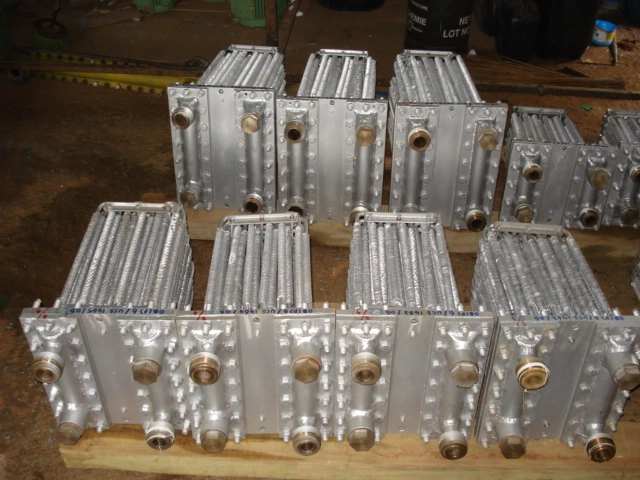
A finned tube heat exchanger is an advanced thermal management device that optimizes heat transfer between two fluids.
In many industries, even a small change in temperature can affect how well machines work and how much they cost to run. Managing heat efficiently is essential to keep systems operating reliably and economically.
A finned tube heat exchanger helps solve this problem by improving how heat moves between two fluids. By increasing the surface area for heat transfer, it allows systems to maintain desired temperatures more efficiently.
However, many engineers and plant workers face recurring issues such as low heat transfer efficiency, rust or corrosion, dirt or debris buildup on fins, and difficulty selecting the right fin type or material. These problems can lead to higher energy consumption, unexpected system shutdowns, and costly repairs.
Most of these issues can be avoided with the right design choices and proper maintenance. Selecting suitable materials, fin types, and following cleaning schedules helps maximize performance and lifespan.
Whether you’re working with HVAC systems, air coolers, or industrial processes, understanding finned tube heat exchangers allows you to keep equipment running efficiently, reduce energy usage, and minimize operational costs over time.
A finned tube heat exchanger is a device that transfers heat between fluids by using tubes with metal fins attached to their outer surface. The fins increase the surface area, allowing efficient heat exchange between gases and liquids. This type of exchanger is commonly used in air heaters, air cooled condensers, and industrial cooling systems.
A finned tube heat exchanger is a highly efficient type of heat transfer equipment designed to enhance thermal performance between two fluids—one flowing inside the tubes and the other moving over the finned surfaces on the outside. The addition of fins significantly increases the surface area available for heat exchange, making it ideal for applications where one of the fluids (typically air or gas) has a low heat transfer coefficient.
The fins are the defining feature of this type of heat exchanger. By extending the outer surface of the tube, fins dramatically increase the effective surface area, allowing more heat to be transferred from the hot fluid to the cooler one.
Key advantages of fins include:
Fins can be made from materials like aluminum, copper, or stainless steel, depending on the thermal and environmental requirements.
As the cooler fluid (such as air) flows across the finned surface, it absorbs heat from the fins. This heated air or gas then exits the exchanger, carrying away the thermal energy. The airflow can be naturally driven by convection or forced using fans or blowers, depending on the desired performance.
This continuous cycle of heat absorption and dissipation ensures that the finned tube heat exchanger maintains a steady and efficient thermal energy transfer process as long as both fluids continue to flow.
| Aspect | Finned Tube Heat Exchanger | Plain Tube Heat Exchanger |
|---|---|---|
| Heat Transfer Area | Increased surface area due to fins | Limited to tube surface area only |
| Efficiency | Higher thermal efficiency, especially for air or gas-side heat transfer | Lower efficiency with gases due to limited area |
| Size | Compact design with high heat transfer per unit volume | Larger size needed for the same performance |
| Applications | HVAC, air heaters, gas coolers, condensers | Liquid-to-liquid exchangers, boilers |
| Maintenance | Requires periodic fin cleaning | Easier to clean plain surfaces |
In summary, finned tube exchangers are preferred when one of the fluids is air or a low-density gas, while plain tube exchangers are sufficient for liquid-to-liquid applications.
Finned tube heat exchangers are classified by fin type and how the fins are attached. Each type works best in certain temperature ranges, pressures, and applications.
These fins run along the length of the tube. They are used when the fluid flows parallel to the tube’s axis.
Benefit: Helps heat move smoothly along the tube.
Used in: Air heaters, gas heaters.
These fins are placed around the tube, perpendicular to the tube’s axis.
Benefit: Increases surface area for better heat transfer.
Used in: Air coolers, condensers.
Examples: Helical/spiral fins, disc-type fins, crimped fins.
Thin metal plates attached perpendicular to the tubes.
Benefit: Creates large surface area and high turbulence, improving heat transfer.
Short rod-shaped fins attached to the tube surface.
Benefit: Increases surface area in a compact design.
Used in: Space-limited heat exchangers or high-efficiency air coolers.
Fins are made from the tube itself. This creates a strong, integral design.
Best for: High durability and heat transfer efficiency.
Fins are wound around the tube in a spiral shape.
Best for: Medium temperatures and airflow applications.
An L-shaped foot is wrapped around the tube.
Best for: Medium temperature, moderate pressure.
Fins are inserted into grooves in the tube.
Best for: High temperature and good thermal contact.
Similar to G-fin but handles higher temperatures.
Best for: High-temperature and high-pressure applications.
Fins are welded directly to the tube.
Best for: Very high temperature or high-pressure systems.
Fins are mechanically pressed onto the tube.
Best for: Low-cost or low-temperature applications.
G-fin and KL-fin are good for higher temperatures.
L-foot and crimped fins are for lower to medium temperatures.
Depends on fin material, tube material, and attachment method.
Extruded and KL-fin types are stronger than L-foot or crimped fins.
HVAC systems, power generation, and chemical processing may need different fin types.
Finned tube heat exchangers are made from different materials for tubes and fins. The choice depends on cost, heat transfer, corrosion resistance, and strength.
Properties: Lightweight, affordable, and excellent thermal conductivity.
Uses: Air-cooled heat exchangers, HVAC systems, and radiators.
Benefits: Good corrosion resistance and heat transfer at a low cost.
Properties: Very high thermal conductivity.
Uses: High-performance applications, sometimes paired with stainless steel tubes.
Benefits: Excellent heat transfer, but more expensive and can oxidize.
Properties: Strong and cost-effective.
Uses: Applications where budget is a concern and corrosion is less critical.
Benefits: Good mechanical strength, but often needs coatings for corrosion protection.
Properties: Strong, durable, and highly corrosion-resistant.
Uses: Harsh environments and extreme temperatures.
Benefits: Long-lasting and strong, but has lower thermal conductivity than aluminum or copper.
Finned tube heat exchangers are widely used because they transfer heat efficiently, save energy, and are durable. The fins increase surface area, which makes heat transfer faster, especially when one fluid is a gas like air.
Finned tube heat exchangers are used in many industries for heating, cooling, and condensation. They are compact, efficient, and versatile, making them ideal for systems that need reliable temperature control.
Used in air conditioning, heating, and ventilation to transfer heat efficiently and maintain comfortable indoor temperatures.
Essential in cold storage, food and beverage industries, and industrial chilling systems for controlling temperature precisely.
Employed in boilers and condensers to improve efficiency by transferring heat from combustion gases to water or steam.
Used in refineries and processing plants to heat or cool fluids, keeping temperatures optimal during production.
Found in car radiators and engine cooling systems to remove heat from engines and maintain safe operating temperatures.
Used in chemical reactors and processing plants for temperature control, ensuring reactions and drug formulations happen under specific conditions.
Applied in pasteurization, dehydration, and sterilization processes to control temperature and maintain product quality and safety.
The fins increase surface area, making heat transfer faster between the fluids.
High thermal performance can be achieved with fewer tubes, saving space.
Reducing the number of tubes can lower costs while maintaining performance.
Designing a finned tube heat exchanger requires balancing heat transfer efficiency, pressure drop, durability, and cost. Key factors include fin material, geometry, tube material, airflow, and maintenance needs.
Fin Density (FPI): More fins per inch increase the heat transfer area, but can raise pressure drop and make fouling more likely.
Fin Height and Thickness: Taller and thicker fins improve surface area and rigidity. The design must balance efficiency and structural support.
Fin Material: Common choices are aluminum (lightweight and corrosion-resistant) and copper (excellent thermal conductivity).
Fin Geometry: Shapes like wavy fins can improve airflow and reduce pressure drop, enhancing performance.
Total Heat Exchange Area: Bigger surface areas usually increase efficiency but also raise size and cost. It is calculated based on heat load, fluid properties, and heat transfer coefficients.
Fin Efficiency: Fins must effectively transfer heat. Poor efficiency can create a thermal barrier, reducing overall performance.
Airflow Patterns: Proper airflow over the fins is essential for optimal heat exchange.
Face Velocity: Must balance heat transfer capacity with pressure drop and noise.
Pressure Drop: High fin density and poor geometry can increase air-side pressure drop, leading to higher energy costs.
Tube Material and Dimensions: Tube diameter and wall thickness depend on pressure, temperature, and corrosion requirements.
Circuiting: Tube layout (parallel or counterflow) affects pressure drop and temperature profile.
Fluid Properties: Viscosity, fouling tendency, and allowable pressure drop determine tube count and arrangement.
Material Selection: Tubes and fins must balance thermal conductivity, corrosion resistance, strength, and cost.
Maintenance: Design should allow easy cleaning to prevent fouling and maintain heat transfer efficiency.
Customization: Heat exchangers can be custom-built for specific flow rates, temperatures, pressures, and space constraints.
To keep finned tube heat exchangers running efficiently, it is important to maintain the system regularly and optimize performance. Proper maintenance extends equipment life, prevents costly downtime, and ensures maximum heat transfer efficiency.
Regular cleaning removes fouling, dust, and scale from fins and tubes. This prevents efficiency loss.
Check fluids for contaminants or changes in properties. Poor fluid quality can damage the tubes or reduce performance.
Set up a scheduled maintenance program to address potential problems before they become serious.
Inspect fins and tubes for damage or deformation. Damaged fins reduce heat transfer efficiency.
Adjust fluid velocity, temperature difference, and flow rate to achieve peak performance.
Use tools like Computational Fluid Dynamics (CFD) to simulate airflow and fluid flow, helping optimize design before building the unit.
Consider advanced materials or tube designs, such as low-finned tubes, to improve heat transfer efficiency and durability.
Adopt Industry 4.0 solutions, combining AI and digital twins for predictive maintenance and operational insights.
Choose the right flow arrangement—parallel, counterflow, or crossflow—and fin type—transverse or longitudinal—for optimal heat transfer.
Use heat recovery systems to capture and reuse waste heat, improving overall energy efficiency.
Choosing the right heat exchanger depends on efficiency, space, pressure, temperature, and cost. Finned tube heat exchangers are compact and versatile, but other types like plate, shell and tube, and double pipe exchangers also have advantages.
| Heat Exchanger Type | Key Features | Advantages | Disadvantages |
|---|---|---|---|
| Finned Tube | Tubes with attached fins to increase surface area | Compact, cost-effective for fluids with low heat transfer, versatile for different fluids | Less efficient than plate exchangers |
| Plain Tube | Standard tubes with no fins | Simple design | Lower heat transfer efficiency, needs more space for same performance |
| Plate | Thin, stacked plates with alternating fluid channels | Very high efficiency, compact, ideal for space-limited areas | Not suitable for high-pressure applications |
| Shell and Tube | Tubes inside a larger shell, with one fluid in the tubes and another around them | Ideal for high-pressure and high-temperature applications, widely used in heavy industries | Can be bulky, less efficient than plate exchangers |
| Double Pipe | A single tube inside a larger pipe | Simple construction and easy maintenance | Low efficiency, takes up more space |
At United Cooling Systems, we solve the common problem of inefficient cooling and high energy costs. Our finned tube heat exchangers are designed to transfer heat faster and more efficiently than standard systems.
Many businesses and industries struggle with uneven cooling, system wear, and frequent maintenance. Our solutions fix these issues, providing consistent performance and longer equipment life.
With United Cooling Systems, you get a finned tube heat exchanger that keeps your system running smoothly, reduces energy bills, and lowers maintenance headaches. We focus on solving the cooling problems that matter most to you.
A Finned Tube Heat Exchanger is a device that transfers heat between fluids using tubes with extended fins to increase surface area. The fins improve heat transfer efficiency while keeping the exchanger compact and effective.
It works by allowing a fluid to flow inside the tubes while another fluid flows outside over the fins. The fins increase surface area, improving heat transfer between the two fluids.
The main types include longitudinal fin, transverse fin, spiral fin, and annular fin exchangers. Each type is selected based on heat transfer efficiency, pressure drop, and application requirements.
Common materials include copper, aluminum, carbon steel, and stainless steel. Material choice depends on thermal conductivity, corrosion resistance, and the fluids used.
Selection depends on fluid type, temperature difference, flow rate, pressure drop, and maintenance requirements. Proper sizing ensures optimal heat transfer and energy efficiency.
They offer higher heat transfer rates, compact size, lower cost, and easy maintenance compared to bare tube exchangers, making them ideal for HVAC and industrial applications.
Issues include fouling, corrosion, vibration, and fin damage. These problems reduce efficiency and require regular inspection and maintenance.
Cleaning involves brushing, water jetting, or chemical cleaning, depending on fouling type. Regular maintenance prevents efficiency loss and extends equipment life.
They are used in HVAC, power generation, chemical processing, oil & gas, and refrigeration due to their efficiency and adaptability to various fluids.
Consider tube diameter, fin density, material, flow arrangement, and pressure drop. Proper design ensures maximum heat transfer efficiency and long-term reliability.